Using the Game
Kolb’s Learning Cycle and the Game
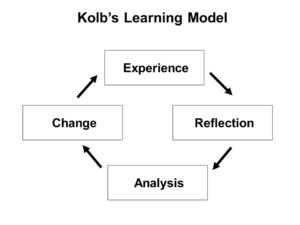
David Kolb devised a simple, sensible model for learning, a cycle that includes experience, reflection, analysis, and change. It is called a “learning cycle” because after we change something, try something, we experience what we’ve changed, and around we go again…and again….
Here is a description of each of these four steps as it applies to Home Sweet Homelessness.
- Experience: Home Sweet Homelessness, when played as described here, has consistently provided a powerful But as we know from our own lives, we often fail to learn from experience alone. At University of Detroit Mercy’s Leadership Development Institute, David Kolb’s Learning Model has served as a powerful guide, to use experience, as a first step in an effective model of learning and change. The following is a guide to going beyond the essentials of guiding the game, to using the game to guide growth, development, improvement, and change.
- Reflection (How did I feel? What did I notice?) Evaluation of the game. While the game was in the intensive testing and evaluation phase, we discovered that evaluation of the game provided a natural reflection on the players’ experiences. When groups were asked to agree on rating the effectiveness of various aspects of the game, what ensued was a reflective sharing by the players of what the experience was like for them. For that reason, an evaluation form is provided at the end of this guide, and is also available by e-mailing us at HomeSweetHomeless@gmail.com . The instructions are on the form. Give one evaluation to each play group, and ask them to agree on evaluation input. If you have more than one group playing, consider whether to have the groups report to the assembly on the items that you (or they) find most appropriate or interesting. Follow the return instructions on the evaluations to participate in our ongoing Home Sweet Homelessness Learning Community. More on this at the end. Design your own reflection exercises that suit your time and format constraints to help the players stop and internalize their experience. Resources are available on our website, HomeSweetHomelessness.org.
- Analysis (What meaning do I find in this regarding homelessness? What other sources of information can I find to understand it better?) This is an opportunity to provide information. The players are concerned and curious. They are aching about this, and want to know more. One ready source of information is the people already gathered. Think of pairing small groups, or even forming as a whole for some Q&A among participants. If your group is large enough, it will include enough people who have been homeless able to share their knowledge. Another simple and organic approach is to include a panel of local providers, advocates, and leaders for Q&A and discussion. If they had joined in the game, even better.
- Change (How can we take what we have learned and try to improve things?) This step is something that enables you to engage the players in the work of your agency, school, or community. They are already formed as a team. They have shared their hearts and their thoughts. They have established trust and, in the evaluation have even learned to work together toward a result. Perhaps an example would help here: We worked with a District Court staff in a half-day workshop. We brought Liz and Lynn, the other two inventors of the game, and ten current guests of the Goodwill Inn who had played the game together once. Each of these ten sat at a table, and was joined by four members of the Court Staff – from secretaries to judges. After playing the game for 50 minutes and evaluating it as above, we paired the groups of five into groups of ten and gave them a worksheet with two questions for their group to answer together. “Given the experience that you just shared playing Home Sweet Homeless together, what improvements would you make in the Court to help it meet its mission?” “Given the experience that you just shared playing Home Sweet Homeless together, what improvements would you make in your personal lives to be more human?” The result was an action plan…for the Court that served the public including those without homes. Energized, engaged, strategic…in just 2 hours!
Purchase Products
Connect With Us